
Food Journalling
Keeping a Record: What Food Journalling Reveals About Habitual Snacking
Eleanor Whitfield · 10 min read
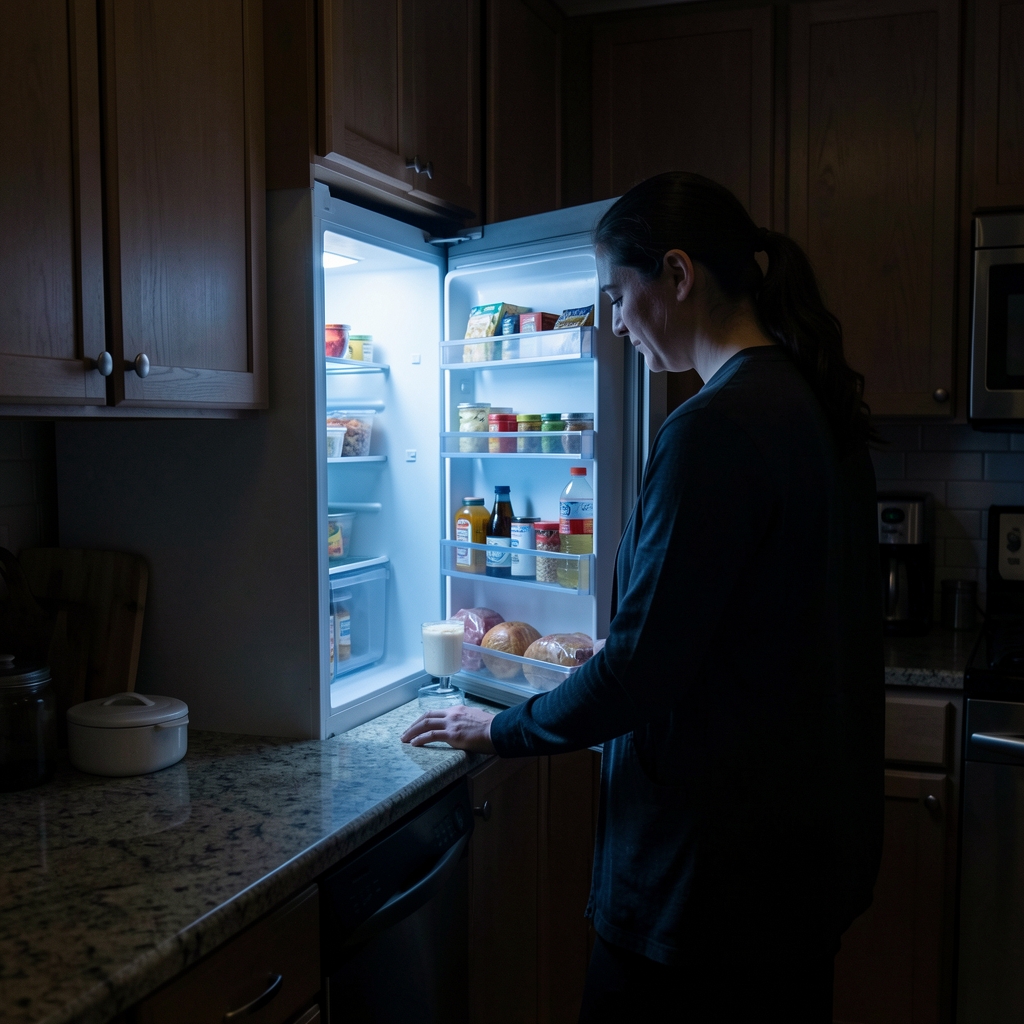
After the evening meal, the kitchen often falls quiet — and then, an hour or two later, the refrigerator door opens again. This secondary visit, unplanned and not preceded by any awareness of physical need, is one of the most consistently reported patterns in studies of habitual snacking and eating without hunger. Understanding what drives it requires looking beyond appetite toward the situational cues and emotional states that converge in the late evening hours.
The hours between eight and eleven in the evening occupy a particular position in the daily eating rhythm. Structured obligations — work, commuting, preparing meals for others — have receded. The environment shifts from active to passive. The body settles into a lower register of activity, and the mind, freed from the forward pressure of the day, begins to process what was left unresolved.
It is in this particular window that eating without hunger becomes most likely. Research into weekend eating patterns and weekday evening eating notes a consistent finding: the later in the day a person eats, the less likely that eating episode correlates with reported physical hunger at the time. The relationship between the meal and the body's need for energy loosens as the evening advances.
This dissociation — eating that does not arise from the physical signal of an empty stomach — is one of the defining characteristics of emotional eating patterns. The late evening creates conditions that favour it: reduced self-monitoring, proximity to food in a domestic environment, and the presence of states that research associates with eating triggers, including mild boredom, restlessness, or the residual tension of unfinished tasks.

FIELD NOTE — The domestic kitchen as a fixed environmental cue. Proximity to food increases the frequency of unplanned eating visits during evening hours.
The eating environment is among the most consistently cited factors in research on habitual snacking. A home setting in which food is visible, accessible, and associated with specific daily rituals — the evening snack, the television biscuit, the post-dinner piece of fruit that becomes a piece of chocolate — functions as a persistent cue structure. These cues do not require hunger to activate; they require only the context in which they were first established.
Comfort food habits are particularly tied to place. The same person who shows strong self-regulation around food in an office setting may find that boundary dissolves entirely when they sit in the same chair, at the same hour, in front of the same screen where they previously ate out of boredom or low-level stress. The cue is not the food — it is the chair. It is the hour. It is the particular quality of the ambient light.
This is what makes the eating environment such a useful lens for examining night-time eating. The behaviour is not chaotic or random; it follows a geography. Mapping that geography — which rooms, which hours, which objects — is one of the first practical steps that food journalling makes possible.
"The cue is not the food. It is the chair. It is the hour. It is the particular quality of the ambient light."
Physical hunger builds gradually. It arrives with specific body-based sensations — an empty or hollow feeling in the stomach region, reduced energy, sometimes mild difficulty concentrating. It does not demand a particular food. A person experiencing physical hunger will generally eat whatever is available.
Emotional hunger operates differently. It tends to arrive suddenly, or has been present at a low level across the evening without being recognised as food-related until the kitchen is already entered. It often demands a specific category of food — typically something dense, sweet, or salty — which is itself a useful signal, because physical hunger does not show strong category preference. Emotional hunger also frequently persists through eating: the first portion does not resolve it, because the resolution it is seeking is not nutritional.
Research on the food and mood connection documents this pattern across a wide range of contexts. The association between elevated emotional arousal — whether positive, such as excitement or relief, or negative, such as low-level anxiety or the flatness that follows a tense day — and increased food intake without corresponding physical need is among the more robust findings in the field of eating behaviour observation.
Becoming aware of the distinction between these two signals is not an analytical exercise; it is, initially, a perceptual one. It requires pausing, briefly, at the moment of food-seeking to ask a simple question: where is this impulse coming from? Is it the stomach, or is it somewhere else?
Among the emotional states associated with eating without hunger, boredom holds a distinctive position. Unlike stress — which is widely recognised as a driver of comfort food consumption — boredom carries less narrative weight. It is not dramatic. It does not feel like something that requires attention. This is precisely what makes it effective as an eating trigger.
Boredom eating in the late evening follows a recognisable sequence. The person is not engaged — not in conversation, not in a task that requires sustained attention, not in physical activity. The environment is familiar to the point of invisibility. Time is present but unstructured. In this gap, food offers a low-threshold source of stimulation: it requires action (getting up, selecting, preparing or unwrapping), it engages sensory attention, and it produces an immediate mild shift in state.
The habit-based approach to understanding this pattern does not frame boredom eating as a personal failing. It frames it as a learned response — a routine that developed because it worked, reliably, as a way of filling a particular quality of empty time. Understanding its function is the precondition for noticing it more consistently and, eventually, for choosing differently.
Mindful eating awareness, as it is discussed in the published research on eating behaviour, does not require a formal practice or a dramatic shift in routine. At its most basic level, it is the introduction of a pause between impulse and action — a moment in which the eating trigger can be noticed rather than automatically followed.
In the context of night-time eating, this pause might take the form of a simple check before entering the kitchen: noting the time, noting whether a meal was eaten within the previous two or three hours, noting the current emotional register. These are not elaborate assessments. They are quick, habitual observations that, practised consistently, begin to develop into a reliable internal signal — the capacity to register fullness cues and absence of hunger before rather than after eating begins.
Slowing down at mealtimes — attending to the pace and texture of eating during the main meal of the day — has also been associated with stronger post-meal fullness awareness, which may reduce the likelihood of additional eating episodes in the hours that follow. The connection between eating pace and fullness is consistent across multiple research contexts, though individual variation is substantial.

Eleanor Whitfield is a contributing editor at Felnora Review, where she covers the relationship between everyday habits, emotional states, and eating behaviour. Her work draws on published nutritional research and first-person observational reporting.
More from Eleanor Whitfield →